


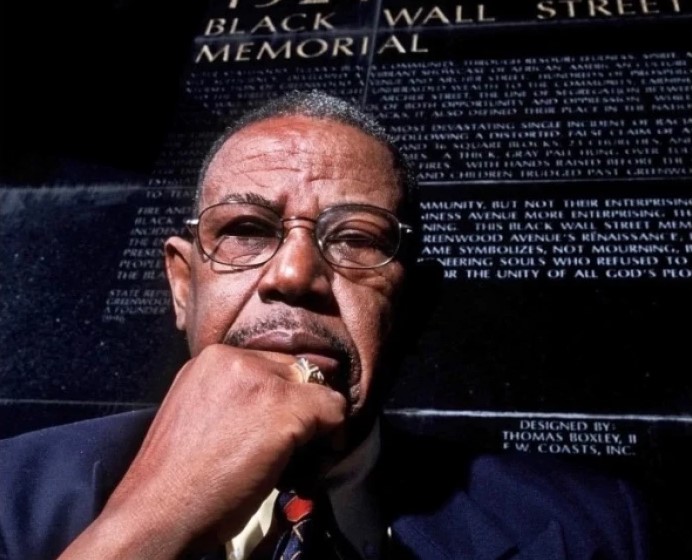
TULSA, Okla. — Former State Representative Don Ross has passed away on Tuesday, May 5 at the age of 85.
The Tulsa native spent 20 years in the Oklahoma House of Representatives, from 1982 until 2002. Heralded as a Civil Rights leader in the state, Ross was vital in the establishment of the Greenwood Cultural Center, the 2001 Tulsa Race Riot (Massacre) Commission, and the Tulsa Reconciliation Education Scholarship, and the removal of the Confederate Flag from the Oklahoma Capitol grounds.
Working alongside the late state Rep. Maxine Horner – also from Tulsa – Ross was credited with bringing more than $79 million state funding to the predominantly Black community he served to help fund health care and programs for children and senior citizens.
Born in Tulsa in 1941, Ross graduated from Booker T. Washington High School with the Class of 1959. While in high school, he first heard about the Tulsa Race Massacre of 1921 and pledged that the world would know about it as well.
Ross served in the U.S. Air Force for four years. He then returned to Tulsa and in 1959 began work at a local bakery. He enrolled as a student at the University of Central Oklahoma (then known as Central State) in the mid 1960s, but would not complete his degree until 1986. He later studied at the University of Tulsa’s College of Law, Rutgers University and Columbia University.
Ross was influenced by Civil Rights leaders like the Rev. Dr. Martin Luther King, Jr., and attended the historic 1963 March on Washington for Jobs and Freedom. He also participated in the Chicago-based Congress of Racial Equality (CORE), an interracial group of students committed to nonviolent action. He picketed against segregation and discrimination in his hometown of Tulsa, as well.
Ross began working at the Oklahoma Eagle newspaper in 1963, where he reported on local news and wrote a weekly column. In 1971, Ross helped found Oklahoma Impact Magazine, which published an article called “Profile of a Race Riot” on the 50th anniversary of the Tulsa Race Massacre.
In 1982, Ross was elected to the Oklahoma House of Representatives. During his 20 years in the House, Ross focused on issues such as education, the arts, labor relations, economic development and affirmative action. He authored Oklahoma’s first affirmative action law (establishing preferences for minority vendors) and affirmative action goals for higher education. He also helped to establish Dr. Martin Luther King, Jr.’s birthday as a state holiday, even lobbying to rename I-244 – a highway constructed directly through the Greenwood District – after Dr. King. As a state representative he improved health and social services for minorities and helped develop of the Greenwood Cultural Center.
Ross considered his most satisfying accomplishment his fight to take down the Confederate flag flying above the Oklahoma Capitol building.
“When I was sworn in in 1984, my son Edward was with me. He asked why we flew that flag. I had no answer for him. I had never noticed it,” Ross said in interviews. As a result of his efforts, in 1989 Oklahoma became the first state in the nation to take down the Confederate flag above its governmental buildings.
Rep. Ronald Stewart, D-Tulsa, said Oklahoma mourns the loss of “one of its most impactful and historic voices.”
“Representative Don Ross lived a life defined by courage, conviction, service, and purpose. His contributions to Oklahoma stretched across generations and across multiple arenas of public life. He was not only a legislator, but also a respected journalist, civil rights advocate, businessman, educator, and champion for Black communities throughout our state,” Stewart said.
“Before serving in the Oklahoma Legislature, Representative Ross used his voice and platform through Black media and community journalism to shine light on injustice and uplift stories that too often went unheard,” Stewart continued. “His commitment to truth and advocacy helped shape important conversations surrounding civil rights, equality, and opportunity in Oklahoma… For many of us serving today, whether directly or indirectly, we are beneficiaries of pathways he helped create through sacrifice, persistence, and leadership… As someone who now serves in these same legislative halls, I recognize the significance of the shoulders we stand on. Men like Representative Ross carried burdens many will never fully understand, yet he continued the work anyway—with grace, resilience, and purpose.”
Sen. Regina Goodwin, D-Tulsa, also issued a statement remembering Ross as “a courageous, effective leader as he eloquently spoke the uncut truth, advocating for justice and progress at the Oklahoma State Capitol during his twenty years of service.”
“He was a strong, respected Black man who loved his Greenwood community,” Goodwin said. “In a Democratic majority-led Legislature, Representative Ross spent a decade as the chair of the Appropriations and Budget Subcommittee on Health and Social Services and helped bring more than $45 million in much-needed funding to his district. He previously served in the Air Force, fighting for a greater America as a descendant of survivors of the 1921 Tulsa Race Massacre.
It was my honor to grow up knowing him and to do my best to lengthen his legacy, having once held his House District 73 seat and now my working in the Senate. We do well to try daily to demonstrate his passionate and productive service.”
Former state Sen. Connie Johnson – who is currently running for Governor of Oklahoma – also recalled her time serving alongside Ross.
“It was my privilege and honor to work with Rep. Ross to write legislation that greatly impacted the lives of people in Tulsa and in the State of Oklahoma via the 1921 Race Riot Commission and establishing Oklahoma’s Juneteenth Holiday.
“A prolific writer, Representative Ross and Senator Maxine Horner were a force to be reckoned with in the Oklahoma Legislature in the 1980s,” Johnson said.



